

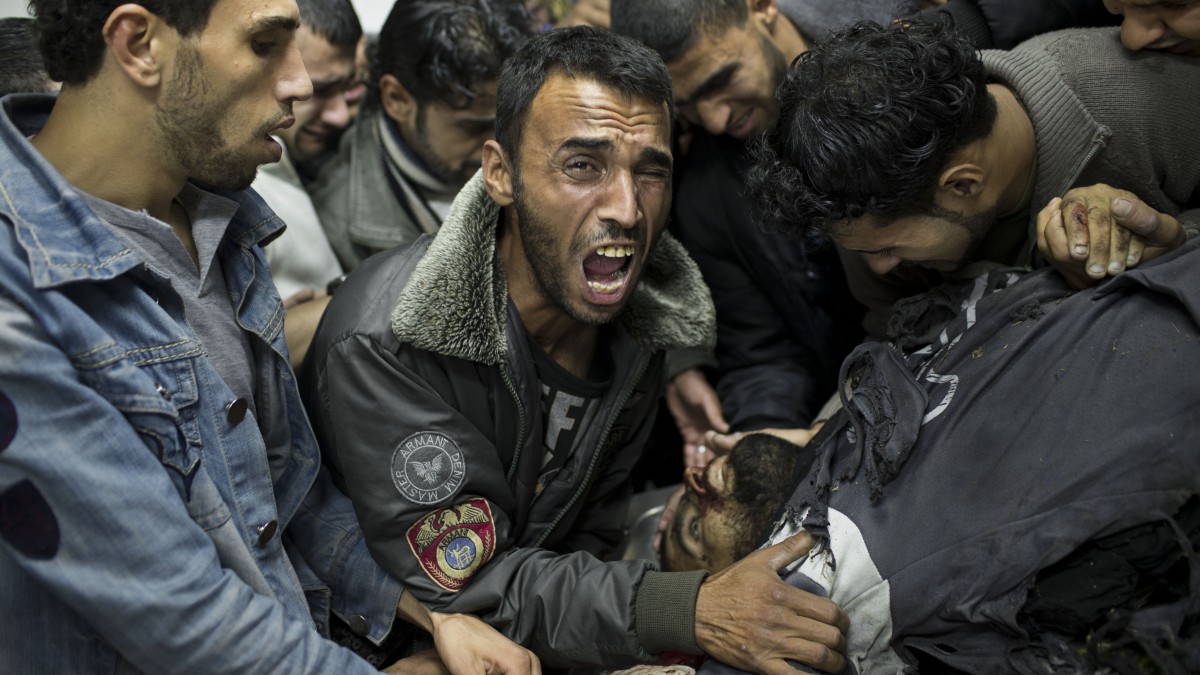

(NEW YORK) MintPress – While Israel and Hamas have agreed to a cease fire after eight days of fierce fighting, the week of violence has claimed the lives of numerous civilians on both sides.
Among the casualties have been women, children and journalists. On Tuesday, two cameramen working for Al-Aqsa TV, the official Hamas-run channel, and an educational programming director for the Al Quds channel, also affiliated with the Hamas government, were killed by Israeli Defense Forces (IDF) air strikes on their cars.
The cameramen were killed near the main Shifa hospital in Gaza City. The Al-Quds program director was killed in the center of the Gaza Strip.
“The Israeli aggressors want to cut the picture and silence the voice of the brave people of Gaza,” Hamas spokesman Fawzi Barhoum told a news conference. “Journalism in Gaza plays a major, effective role in exposing the enemy’s crimes to the world.”
For its part, Israel says it aims to strike only combatants and warns civilians away from its targets, yet critics say that is difficult in one of the most densely populated areas in the world where there are no shelters and civilians, who are over 50 percent under the age of 20 years old, run to hospitals and schools for safety.
“The terrorists use schools, mosques, the media and even their own kids as human shields,” asserted Israeli army spokesman Arye Shalicar.
“Every time we target a site, and we have hit more than 1,400 targets, we try to have nearly 100 percent certainty about where and what the target is, so that we only strike the terrorists,” he said.
Meanwhile, a tower block housing international media offices, including Germany’s ADR, Russia’s Russia Today and Britain’s Sky TV, has been bombed twice in recent days.
The Israeli military said the strikes targeted Hamas communications equipment on the buildings’ rooftops and accused the group of using journalists as “human shields.”
Tenants of one of the buildings hit on Sunday said they did not realise militants occupied the offices targeted.
A similar attack on the same morning occurred on a second building, also crowded with media offices, housing Al-Quds TV.
The assaults wounded six Palestinian journalists, including one who lost a leg and damaged the equipment of some foreign media outlets.
International media, watchdogs react
Press freedom advocates later urged Israel to respect journalists’ status as civilians, regardless of their political leanings.
According to the Committee to Protect Journalists, Israeli forces have killed 10 Palestinian and international journalists in the West Bank and Gaza since 2000.
“Journalists are civilians and are protected under international law in military conflict,” said CPJ Deputy Director Robert Mahoney in a statement on Monday. “Israel knows this and should cease targeting facilities housing media organizations and journalists immediately.”
Reporters Without Borders also weighed in. Christophe Deloire, the director of its international headquarters in Paris, called the attacks unjustified and a threat to freedom of information. He demanded an investigation into the circumstances of the raid.
“Even though the outlets targeted are linked to Hamas, it does not legitimize the attacks,” he said. “Attacks against civilian targets constitute war crimes.”
Meanwhile, in Moscow, Russia Today reported that the office of its Arabic-language channel, Rusiya Al-Yaum, was heavily damaged in the strike but none of the crew was injured.
“Fortunately for them, they had left the Shawa building about an hour before the Israeli planes delivered the strike,” said a spokesperson. “RT’s office was damaged, so the crew will move to a less-affected floor of the center.”
ARD said its Gaza office was also hit. “Thanks God, nobody was injured,” said correspondent Markus Rosch in a blog entry on the broadcaster’s website. “At night, I went to bed hoping for a ceasefire. But in the morning it went off again on both sides.”
Sky News Arabia, a joint venture between BSkyB in Britain and the Abu Dhabi Investment Corp., issued a statement condemning the attacks and saying they caused extensive damage to its property and “considerable and unacceptable distress to our staff.”
The statement claimed the Israeli attacks “targeted journalists covering the current military operations in Gaza” and demanded “that Israeli authorities respect and abide by the international conventions not to target media and to ensure the safety of journalists covering conflict zones.”
Freedom of the press
The American media meanwhile dodged a bullet of its own in the wake of a ruling by a federal court judge in May that blocked the section of last year’s National Defense Authorization Act (NDAA) stating that people eligible for detention are those who have “substantially” supported al-Qaida or any of its “associated groups.”
A group of activists and journalists had argued that the vague wording of the law could subject them to indefinite military detention because their work brings them into contact with people whom the U.S. considers to be terrorists, including Hamas.
Judge Katherine B. Forrest of the Southern District of New York agreed with them, saying it likely violated the First and Fifth Amendments of U.S. citizens.
She rejected the Obama administration’s argument that the NDAA merely reaffirmed an existing law recognizing the military’s right to perform certain routine duties.
Among the plaintiffs in the lawsuit was Chris Hedges, a former foreign correspondent for the New York Times and part of a team of reporters who won the Pulitzer Prize in 2002 for the paper’s coverage of global terror.
Speaking to Democracy Now after the ruling, Hedges explained that he had decided to sue President Obama “Because I, as a foreign correspondent, had had direct contact with—when I went through the list, the State Department terrorism list—17 organizations that are on that list, from al-Qaida to Hamas to Hezbollah to the PKK, and there was no provision within that particular section to exempt journalists.”
As for the judge’s ruling, he said, “It was quite a courageous decision—I think, clearly, a correct one.”
The U.S. press corps may have won that battle in the courts, but it, along with its colleagues worldwide, remains at great risk on the ground elsewhere.